Introduction
For many years, the choice of office space was driven by relatively stable criteria: central location, adequate square footage and sustainable costs. Within this model, the office was primarily considered an operational container designed to support everyday business activities.
In recent years, however, this approach has started to reveal its limitations. The evolution of working models, growing attention towards employee wellbeing and the need to create more attractive work environments have led companies to rethink the role of physical space.
Within this context, the comparison between traditional offices and business parks has become increasingly relevant. This is no longer simply a choice between two real estate typologies, but between two different organisational models.
The Traditional Office: An Increasingly Rigid Model
Traditional office spaces — especially within consolidated urban environments — are often built around rigid structures. Spaces are designed to meet specific initial requirements, but tend to become less efficient over time, particularly when organisations evolve or expand.
Service management represents another critical aspect. In many cases, companies are required to coordinate suppliers, maintenance, security and operational services directly, increasing overall management complexity
This is often combined with limited opportunities to integrate collaborative spaces, wellbeing-focused areas or event facilities, which typically require external solutions or inefficient adaptations.
The Business Park: Infrastructure Designed to Evolve
The business park model was created to respond to these limitations. Rather than simply being a group of office buildings, a business park is conceived as an integrated system designed to provide flexibility, services and infrastructure.
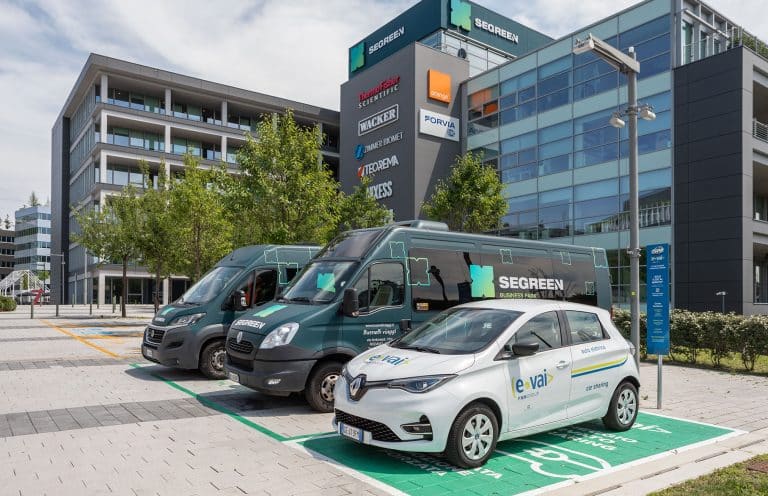
Within a context such as Segreen Business Park, companies can access spaces that evolve over time, adapting layouts and surfaces according to changing operational needs. This flexibility allows organisations to support growth and transformation without the need to completely rethink their headquarters.
At the same time, integrated services reduce operational complexity while ensuring consistently high-quality standards.
Workplace Experience & Quality of Space
One of the most significant differences between the two models concerns the everyday experience of employees.
In traditional office environments, the workplace is often limited to the internal office space itself, with limited access to services or opportunities for interaction. This can directly impact the quality of the working day and the overall perception of the company.
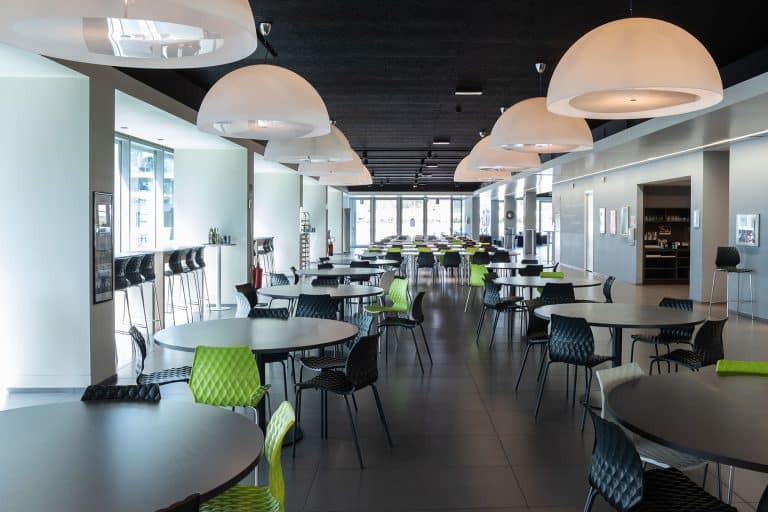
Within a business park, by contrast, the experience extends beyond the office. Shared areas, integrated services, green spaces and dedicated infrastructure contribute to creating a more dynamic and multifaceted environment.
This aspect becomes particularly valuable in a context where companies increasingly compete through the quality and attractiveness of their workplaces.
Impact on Organisation & Productivity
The choice of workspace directly affects organisational efficiency. Rigid environments tend to limit adaptability, while flexible spaces allow companies to respond more effectively to change.
The business park model encourages:
- greater scalability of office spaces
- integration between different business functions
- reduction of operational inefficiencies
This results in improved productivity and stronger alignment between workspace and organisational structure.
Brand Positioning & Corporate Perception
One often underestimated aspect is the role workplace environments play in shaping corporate identity.
A headquarters is not simply an operational location, but a space that communicates values, culture and strategic vision. Operating within a structured, sustainable and well-organised environment strengthens brand perception both internally and externally.
In this sense, a business park such as Segreen enables companies to align their headquarters with a contemporary positioning focused on innovation, sustainability and workplace quality.
An Increasingly Strategic Decision
The comparison between traditional offices and business parks can no longer be reduced to economic or logistical evaluations alone. It is a strategic decision that impacts multiple dimensions: organisation, wellbeing, attractiveness and long-term growth potential.
An increasing number of companies seeking office spaces in East Milan are moving towards more advanced workplace models capable of responding to both present and future needs.
Segreen fits naturally into this scenario, offering an infrastructure designed to overcome the limitations of traditional office environments and support companies over time.
Conclusion
Choosing between a traditional office and a business park ultimately means choosing between two different visions of work.
On one side, a static model designed around fixed requirements. On the other, a dynamic system designed to evolve alongside the company itself.
In a business landscape where change has become the norm, the second option is becoming increasingly relevant.